

From where will liturgical renewal come?
October 19, 2026
By Matt Julius, Project Lead - Liturgical Renewal Project
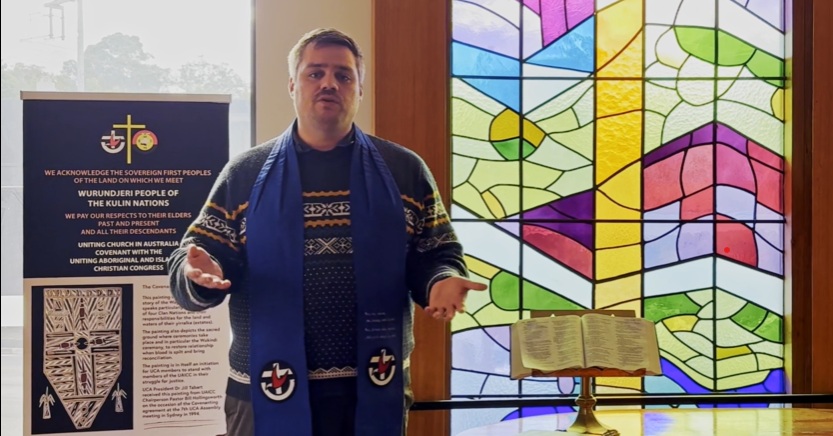
I recently attended the Australian Academy of Liturgy (AAL) conference, Liturgy Under the Southern Cross. AAL brings together liturgical scholars from different churches across Australia to reflect on Christian worship and its connections to the “public work” of the church (which is what “liturgy” means). The theme of the conference invited particular attention to questions of decolonising liturgy, and inculturating liturgy to the contexts of Australia. Below is an abridged version of the paper I presented focusing on liturgical renewal in the Uniting Church, with the title: ‘Ecumenism, Ordo and Catholicity: Liturgical Renewal in the Uniting Church in Australia.’
The Uniting Church in Australia (UCA) has begun a project of liturgical renewal. The key liturgical questions currently facing the UCA become clearer when the “on the ground” realities of the UCA’s worshipping life come into dialogue with the UCA’s inheritance from the liturgical tradition. The key categories from this inheritance which will structure this paper are: ecumenism, ordo, and catholicity.
Ecumenism: “the whole inhabited world” and the heresy of terra nullius (empty land)
The UCA emerged out of the movements towards church union throughout the 20th century. This context is important for understanding the UCA’s liturgical approach.
Broadly speaking there were 3 major periods of church union in the 20th century:
- Those started by the Edinburgh World Missionary Conference (1910), which sought church union as part of a vision to “convert the world” by the end of the 20th century. This movement led to the formation of the United Church of Canada in 1925, and started the initial (unsuccessful) union conversations in Australia.
- The second period was after the Second World War and the formation of the World Council of Churches in 1948. During the post-War period there was an effort to build global institutions for peace and dialogue, in light of the trauma of the war. It was in this period that the Church of South India was formed, coinciding with Indian independence in 1947.
- The last fertile period of union movements came after the WCC Assembly in New Delhi (1961), with its famous call to unity:
We believe that the unity which is both God’s will and his gift to his Church is being made visible as all in each place who are baptized into Jesus Christ and confess him as Lord and Saviour are brought by the Holy Spirit into one fully committed fellowship, holding the one apostolic faith, preaching the one Gospel, breaking the one bread, joining in common prayer, and having a corporate life reaching out in witness and service to all … in all places …(New Delhi Statement on Unity)
What is notable in this third period, in particular, is the intertwining of union movements and postcolonial movements across the Caribbean, Africa, and the moana of the Pacific. It was during this phase that the UCA was formed, out of conversations stretching back to the 1950s.
This background is important for setting the UCA’s foundations within a broader social and political context, which can often be overlooked in how the UCA tells its own history. The ecumenical movement in the 20th century was not simply about conversations among separated denominations, but about churches working together to engage live issues in the wider world: global mission (1910), global peace and dialogue (1948), and the rise of post-colonial nationalism (1961 and beyond).
Ecumenism is about the unity of God which is a gift for all creation as we discover in a new way what the Gospel (and therefore the church) means in new contexts. This means being willing to set aside denominational identities (often imported as part of missionary and colonial movements) to more fully respond to God’s gift and call to “unity in each place … in places.” Ecumenism, therefore, is not simply about reconciliation among different denominations, but reconciliation among all peoples and the whole creation.
In our own context, the heresy of terra nullius in Australia, the view that this land was not occupied by people before colonisation, speaks to a deeper theological terra nullius which fails to recognise God’s presence in this land before the arrival of colonisers and settlers. Where the UCA fails to honour the spiritual and theological insights of First Peoples (particularly in the name of protecting a sense of “tradition”) we are departing from our own ecumenical foundations. In our worshipping lives the UCA must listen to First Peoples in order to discover more fully what God is saying to us in this place now called Australia.
Ordo: the gifts of the Christian life — Bath, Table, Book: prayer and song
Reclaiming the UCA’s foundations in ecumenism also invites us to reclaim the foundations of the structure and pattern of worship, often called the “ordo” of worship (literally “order”). The focus on “order” (in the UCA often set alongside “liberty”) isn’t about imposing a uniform pattern for worship, but rather highlighting the things which help make sense of our shared Christian life.
The Australian liturgical scholar Andrew McGowan points out in his book in Ancient Christian Worship (2014):
The old [understanding of “worship”] is about embodied life and ethics, the new about inner life and aesthetics. No one in the ancient church could have asked about “styles” of worship. … in the ancient world, what we now call “worship” did not quite exist.(Ancient Christian Worship: Early Church Practices in Social, Historical, and Theological Perspective (2014), p. 10?)
The question of ordo is not about a uniform pattern for worship, but the deeper question of the pattern of Christian spirituality. (“Order” is a lot more than black triangles!) The key gifts which structure Christian spirituality — baptism, communion, scripture (and we might add prayer and song) — are not reducible to features of gathered worship, but extend to the whole public work of the church and life of discipleship. These are deeper issues than the style of our worship, and much more about embodied life and ethics.
Some churches focus their service on contemporary worship songs and sermons; other churches have a more structured pattern of scripted prayer (perhaps songs taken from Together in Song), with a central focus on Word and Sacrament. How do we build mutual recognition that these are expressions of a deeper shared Christian spirituality?
How do we work together to invite people into the waters of baptism, and the ongoing life of discipleship in Christ?
How are we continuing to be nourished by the proclamation of the scriptures and sharing the meal in which Christ promises to be present?
How might we think of our prayers and songs as sacramental acts in which God comes to be present among us?
Catholicity: the wholeness of the Church in full human inclusion ( … and creation too)
Lastly, we might think in a fresh way about the catholicity of the UCA (‘catholic’ means ‘universal’ or more literally ‘according to the whole,’ not to be confused with Roman Catholicism). The wholeness of the church is found as it expands to embrace all people, as we participate in God’s work of “reconciliation and renewal of the whole creation” (Basis of Union, para. 3).
The wholeness of the church is discovered precisely in the diverse expressions of the church which expand to celebrate the diversity of the world itself. The task of the church’s catholicity is reconciliation within our difference, not as an erasure of our differences.
When the UCA fails to embrace the full diversity of our church we limit the wholeness of the church. To this end actively embracing the voices of migrant and non-anglo communities within our church is necessary for us to become more fully the church of God.
We might ask whether it is possible for the UCA to speak a language other than English first, rather than always beginning our theologising and worshipping in English? Or we might ask what practices from elsewhere might help us better understand the fullness of God?
What is true of the failure to celebrate and affirm the culturally diverse expressions of Christian spirituality in our church is echoed in all forms of human exclusion.
Two key liturgical scholars in the UCA, Rev. Prof. Stephen Burns and Rev. Annie Brophy (currently undertaking a PhD on UCA Liturgy), call on the UCA to become a “fully humanly inclusive community.”
This means particularly paying attention to those who have been alienated from the church and struggled to have their voices heard: the LGBTQIA+ community, the disability community, the poor, the migrant, and all those who have felt alienated by the UCA’s sometimes narrowness to upper middle-class white Australian culture.
The full human inclusion of the church's worship is simply what it means for the UCA to be the church of the God who reaches out to embrace all people. And as we take First Nations voices more seriously we should also include a deeper embrace of creation itself as well.
Conclusion
We cannot renew our worship as a church by some kind of magic trick. We must wait upon the Spirit to bring renewal. Nonetheless, the wisdom of our tradition points us to some places to look:
God is already present in the whole world, and so we should deepen our relationships with the First Peoples in this land in order to discover God in richer ways.
The pattern of Christian spirituality invites us into the waters of baptism, the sustaining power of scripture and Christ’s communion, and a common life of prayer and song. This deep pattern might help us see in each other a resonant Christian spirituality across divides of style and theology.
Lastly, to discover the wholeness of the church, we must find ways to embrace all people — particularly those who have struggled to find their place and their voice within our church.
“ … the Church does not have a continuing city but seeks one to come. On the way Christ feeds the Church with Word and Sacraments, and it has the gift of the Spirit in order that it may not lose the way.” (Basis of Union, para. 3)