

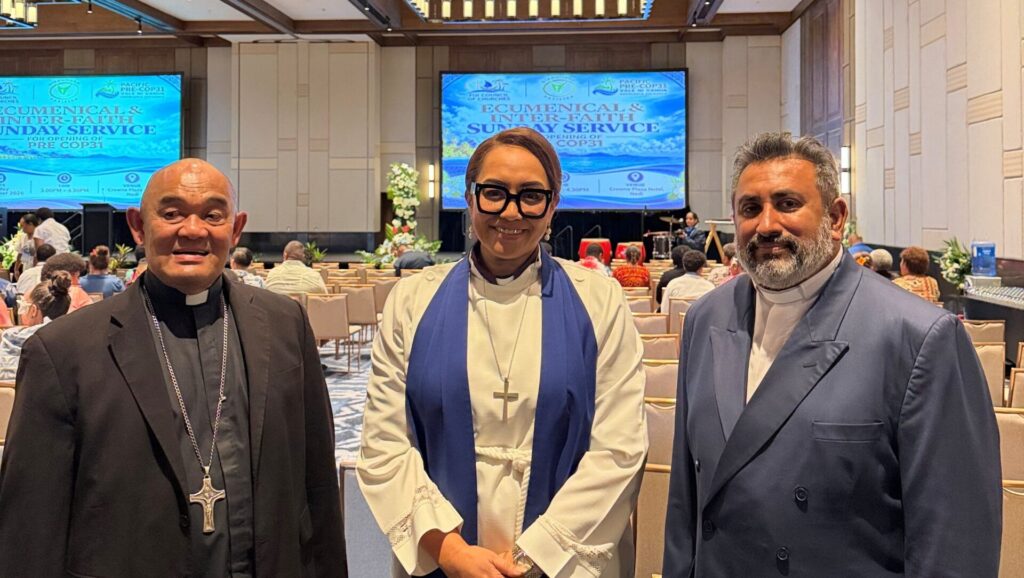
Pacific Church leaders have issued an urgent and deeply faith-filled call for climate justice, declaring that communities on the frontline of climate change need more than praise for their resilience. They need justice and decisive action.
Gathering in Nadi, Fiji, for an Ecumenical Service marking the beginning of Pre-COP31, Pacific faith leaders brought the lived realities of their communities directly to political leaders and delegates preparing for global climate negotiations.
Uniting Church in Australia President Rev Charissa Suli joined church leaders from across the region for the gathering, standing alongside Pacific communities as they called on the world to confront the human and moral consequences of climate change.
Their message was stark:
“We are sinking. We are vulnerable. Resilience is no longer enough.”
In a powerful address, Archbishop of Suva, Peter Loy Chong, challenged the tendency to celebrate Pacific peoples as strong and resilient while failing to confront the forces driving the climate crisis.
Pacific Church leaders warned that praising resilience while continuing to expand fossil fuels can become a “cloak for inaction”, allowing the world to acknowledge the courage of vulnerable communities without taking responsibility for the suffering they endure.
Rather than romanticising resilience, the statement calls on the world to honestly acknowledge the vulnerability of Pacific peoples and the profound injustice they face.
“Do not stand at the foot of our suffering and admire us for how bravely we carry the cross of climate change,” the leaders declare. “Help us take this cross down!”
A summons for climate justice
Four clear calls to COP31 form the heart of the statement, setting out what Pacific Church leaders believe justice demands from governments and the international community.
Pacific Church leaders first demand radical emissions reductions, including an immediate halt to fossil fuel expansion and action to keep global warming strictly within 1.5°C. They describe this not simply as a matter of economics or policy, but as a sacred moral responsibility to the future of humanity.
Second, the churches call for full accountability for Loss and Damage. Communities that have contributed least to global warming, they argue, should not have to bear the financial cost of rebuilding what climate change has destroyed. The leaders also call for recognition of losses that cannot simply be replaced, including sacred cultural heritage.
Third, they call for direct, grant-based climate finance rather than assistance that leaves vulnerable countries carrying greater debt. The statement urges governments and international institutions to remove bureaucratic barriers and deliver resources directly to communities, enabling people to adapt locally or, where necessary, move with dignity.
Finally, the leaders demand genuinely inclusive climate governance. They call for Indigenous elders, resource custodians, women, young people and people with disabilities to have an honoured place in global climate decision-making.
Hope that gives us courage to act
Preaching from Romans 8:18-25 during the ecumenical gathering, President Suli reflected on the image of creation groaning and waiting. She challenged those entrusted with leadership to consider what their choices reveal about the future they are helping to create.
“Our lives, our choices and our exercise of power and leadership” should “show something of the future God has promised,” she said.
President Suli posed a question with particular urgency for leaders making decisions with consequences extending far beyond the negotiating room:
“When our own interests compete with the good of others, what will be revealed?”
She described Christian hope not as passive optimism or certainty that everything will turn out as we want, but as “the courage to act without knowing that everything will turn out as we hope.”
For the Uniting Church in Australia, participating in Pre-COP31 expresses its solidarity with Pacific churches and communities and brings a moral and theological voice to decisions that will profoundly affect present and future generations.
President Suli was joined by the Moderator of the Uniting Church NSW/ACT Synod, Alice Solomon from Uniting NSW/ACT, and Nathan Tyson, representing the National Uniting Aboriginal and Islander Christian Congress (UAICC).
Together they joined Pacific Conference of Churches General Secretary Rev James Bhagwan and church leaders from across the region in a shared ecumenical witness.
From vulnerability to solidarity
Drawing deeply on Christian faith, the Pacific statement describes the climate crisis as a moral wound and calls for an “ecological conversion” in which repentance leads to restitution and justice.
It challenges governments and industries while also inviting the whole Christian community to listen to people already experiencing the consequences of a changing climate.
As political discussions continue, Pacific churches insist that the voices, wisdom and lived realities of their peoples must not remain at the margins of global climate decision-making.
They come to COP31 with clear policy demands and a deeper moral and theological challenge:
“What will our choices, our leadership and our use of power reveal about the future we are prepared to build together?”
Closing with a prayer for transformation, solidarity and courage, the statement calls people of faith and those with the power to act to turn words into justice:
“May God grant us the grace to turn our grief into justice, our vulnerability into solidarity, and our collective will into the salvation of our common home.”
Read the full Pacific Church Leaders’ Statement to COP31 here.