
Meet the 17th Assembly Cato Lecturer
Korean American theologian Grace Ji-Sun Kim has been announced as the presenter of the 17th Assembly Cato Lecture
March 20, 2024
By Rebecca Beisler
The presenter of the Cato Lecture at the 17th Assembly in July will be Korean American theologian Grace Ji-Sun Kim, a world renowned scholar and expert in intercultural, feminist and post-colonial theology.
Grace is the author or editor of 22 books and Professor of Theology at Earlham School of Religion in Richmond, Indiana. She is a much sought after lecturer across the globe and last year Christian media organisation Sojourners named Grace as one of eight women shaping the church.
“ It's one thing to have this thing where you use it as your power and it’s your decision to be made invisible, but it's really another thing when societies themselves make a group invisible. "
Subscribe to our newsletter
If you want to get the latest news from the Uniting Church in Australia then subscribe to our weekly newsletter delivered to your inbox.
Grace told the Assembly this week she was thrilled to be asked to present the Cato Lecture and was looking forward to returning to Australia after making strong connections with the Uniting Church on her visit five years ago.
While not wanting to give too much away, Grace said her lecture will touch on the concepts in several of her books and make connections with the 17th Assembly theme, ‘Threads of Love, Weaving Christ’s Love Across Cultures and Boundaries’.
Grace is an ordained minister within the Presbyterian Church (USA). She was born in Korea, educated in Canada and now teaches in the US. Her book Invisible, listed by Englewood Review of Books as one of 12 Important Theology Books of 2021, explores the marginalisation and oppression of Asian-American women. Borne out of her own experience of xenophobia and racism, Grace discusses the notion of “invisibility” as not only a cultural or social issue but also a spiritual one.
“We talk about in, you know, like Harry Potter, the invisible cloak. It's one thing to have this thing where you use it as your power and it’s your decision to be made invisible, but it's really another thing when societies themselves make a group invisible. Asian Americans here are made invisible by the white dominant society and I’m hoping that the book might be a lens for us to understand how other groups are made invisible.”
Grace listed those from lower socioeconomic backgrounds, the LGBTIQA+ community, people who are disabled, and in today’s context, the Palestinian people, as examples of groups which are made invisible by society.
She speaks about a ‘theology of visibility’ as a way of lifting people up.
“I think in so many ways it's not just Asian Americans that are made invisible, but other groups. And we really need to stop that. Everyone is equal, everyone is created in the image of God and we have to value each other. No life is less valuable than another life.”
Her upcoming book, When God Became White, due for release in May, unpacks and questions the fixation for much of the church on a white male God.
“Many years ago, I took my kids to the Sistine chapel and you see Michaelangelo’s painting of a white male God and you see it all over Europe. Jesus somehow turned into a white male Jesus too. He wasn’t white, but he turned into white. It made me really question, why is this happening when no one has seen God, there is no reference to God being white anywhere in the bible, Old Testament or New Testament. Sure there are male metaphors, and there are female metaphors of who God is as well.”
“Why are we so fixated on this whiteness and this maleness of God? It has to do with power. In the name of God, white male European church leaders have engaged in war and genocide and colonialism and sexism, and the white male God helps them to do it.”
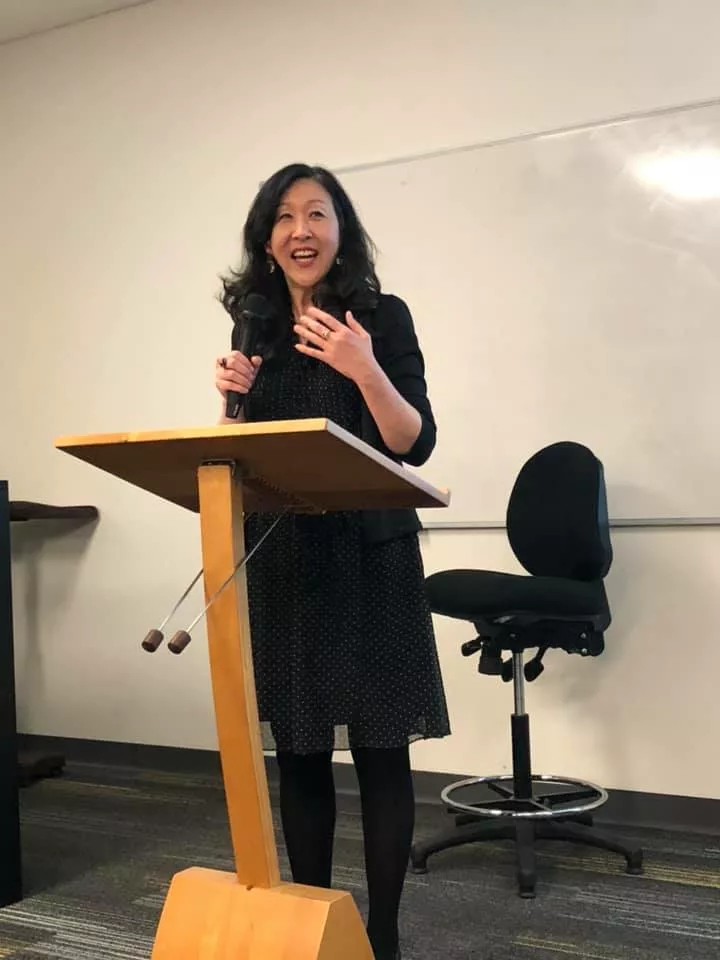

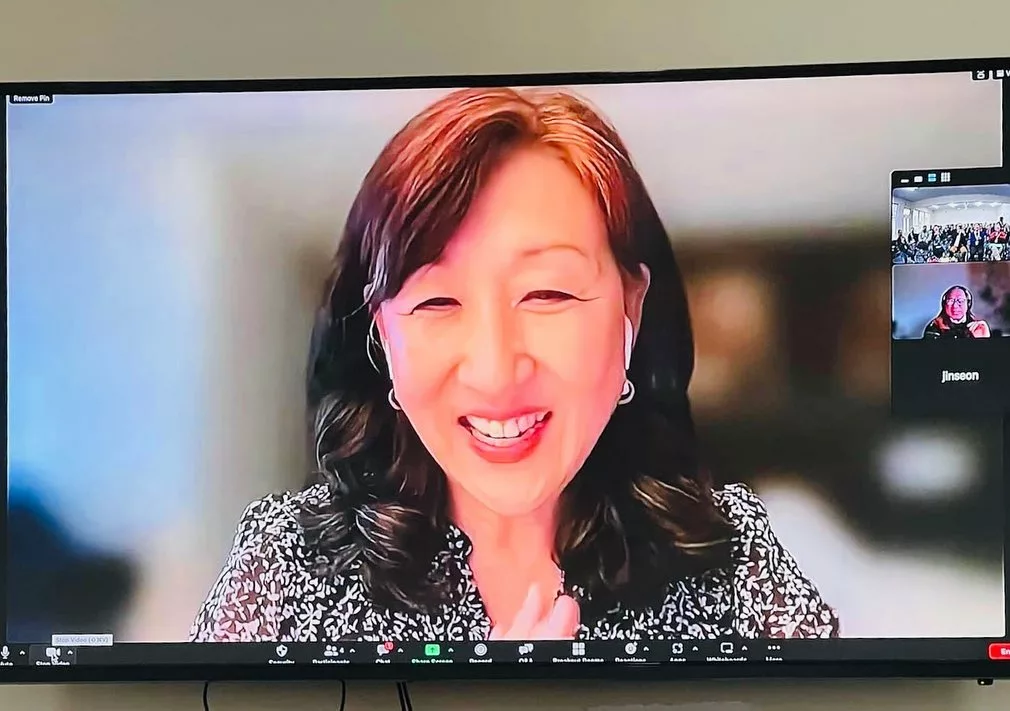
Grace in 2019 at the Uniting College for Leadership & Theology in Adelaide, and speaking to the Korean National Conference online in 2023.
In the book, Grace shows what it might look like to recover the biblical reality of a non-white, non-gendered God.
“I think it is an important topic, especially because the white churches are dropping off or are rapidly declining and it’s in developing countries, or in Africa, Asia, South America, that the churches are slowly growing, so we really need to understand that God is not male and God is not white.”
Grace says she is particularly excited to witness the installation of Charissa, who will be the first Tongan and first person of colour to lead the Uniting Church nationally.
“For her to be the first woman of colour, it’s so exciting to see that happening in Australia. I think that will shed a light for many other denominations too.”
Grace says the 17th Assembly theme and its reminder to embrace the other is an important message for the church today.
“I think the theme really speaks to our time right now. As Christians we speak about love all the time, but we don’t really act on it. The Church really needs to grow on love and what it means to love one another. Even in our own contexts we are afraid of those who are different from us. If a poor person walks into the church, everyone is alarmed. We get afraid of those who are different from us. I think the theme of love and binding, it’s a good theme for us to think about for these three years and beyond.”
Grace said she hoped that the theme and its focus on crossing boundaries would extend beyond the Uniting Church in Australia to other places across the world.
“No church is just an island to themselves. We're all kind of global these days. So I hope that whatever the churches are doing in Australia, it will have an impact in other places, in Asia and in North America, too. We have so much to learn from one another.”
The Cato Lecture is a key feature of the triennial Assembly. It is named after Fred Cato who established the Cato Lectureship in 1932 for the promotion of religion and education.
Find out more about Grace Ji-Sun Kim and her books. Listen to her podcast Madang by The Christian Century.
Related news
Call for nominations for President-elect and 18th Assembly representatives
The Uniting Church in Australia is beginning an important process of discernment to identify the next President-elect of the Assembly. Ahead of the 18th Assembly, the Uniting Aboriginal and Islander Christian Congress (UAICC), Presbyteries and Synods have the privilege and opportunity to identify people who may be nominated for election as President-elect (Reg. 3.6.4.1). Nominations…
Celebrations and stories of healing in Alice Springs
Stories of Healing: Alice Springs marks 100 years of Adelaide House and 70 years of the John Flynn Memorial ChurchIn the red centre of Australia, members of the Uniting Church community gathered on 12–13 September to honour two milestones of faith, care and resilience: the centenary of Adelaide House and 70 years of the John…
Pacific women call for climate action that begins with their communities
Pacific women call for climate action that begins with their communities From Tuvalu, Pacific women are calling on world leaders to listen deeply, strengthen community leadership and pursue climate action grounded in local experience and wisdom.For the women who gathered in Tuvalu this September, climate justice reaches into the everyday work of keeping communities safe.…
Bearing witness to Palestinian Christian voices
Bearing witness to Palestinian Christian voicesAs World Week for Peace in Palestine and Israel takes place this week, the Uniting Church is invited to listen, pray and stand in solidarity with communities longing for peace and justice. In July this year, the Uniting Church hosted two Palestinian Christians as part of the “Bearing Witness: Palestinian…
President’s Prayer for the UN International Day of Peace
President’s Prayer for the United Nations International Day of Peace The United Nations International Day of Peace, commemorated on 21 September, brings people around the world together to reflect on the urgent work of building and sustaining peace. The 2026 theme, “Invest in Peace – For Everyone, Everywhere, Every Day” highlights that peace is…
Come, Taste and See: Feast of Faith 2026
Come, Taste and See: Feast of Faith 2026 Young adults and emerging leaders gathered for this year’s Feast of Faith, discovering God’s goodness through worship, fellowship, storytelling and shared cultural experiencesEarlier this month, second-generation young adults and emerging leaders from intercultural communities across the Uniting Church gathered in Merricks, Victoria for Feast of Faith 2026.…
Lay Preachers gather to share in weaving Christ’s love
Lay Preachers gather to share in weaving Christ’s loveMore than 40 Lay Preachers, worship leaders and church members from across Australia gathered in Naarm/Melbourne from 4–6 September for the National Lay Preachers’ Conference. Hosted by the Lay Preachers’ Association of Victoria and Tasmania with Pilgrim Theological College, the triennial conference was…
Pilgrims of Peace, Trust and Hope
Pilgrims of Peace, Trust and Hope Last week, President-elect Rev Dr Paul Goh gathered with the global ecumenical community to discuss the Church’s role in speaking for peace, justice and hope amid the wounds of divisionSubscribe to our newsletterIf you want to get the latest news from the Uniting Church in Australia then subscribe to…